⚡ TL;DR — Quick Summary
82|-
83|
- Surfer SEO (from $49/mo) — Best dedicated content optimizer. The most granular NLP-driven Content Editor on the market with real-time scoring, detailed term frequency analysis, and a polished writing workflow. Ideal for content teams that want deep optimization without a full SEO suite. AI visibility tracking on Pro plan ($182/mo) and above. 84|
- Semrush (from $139/mo) — Best all-in-one SEO + content platform. The most comprehensive SEO toolkit overall, with keyword research, competitive analysis, site audits, rank tracking, and a solid SEO Writing Assistant. Content optimization is good but not as deep as Surfer or Frase. Best value for teams that need the full SEO picture, not just content. 85|
- Frase (from $15/mo) — Best value content optimizer. The only tool with dedicated dual SEO + GEO scoring for optimizing for both Google and AI search engines. Fast content brief generation, strong SERP analysis, and the lowest entry price among focused content tools. AI writing features included across all plans. 86|
- Ahrefs (from $99/mo) — Best for keyword research and backlink analysis that informs content strategy. The AI Content Helper is a newer, still-maturing addition. Excellent data foundation but content optimization capabilities lag behind dedicated tools. Best for teams that primarily need Ahrefs' core SEO tools and want basic content features included. 87|
- Key insight — Surfer and Frase are specialized content optimization platforms. Semrush and Ahrefs are full SEO suites where content optimization is one feature among many. The price gap reflects this: Surfer and Frase cost $15-$299/month, while Semrush and Ahrefs cost $99-$500/month for comparable plans. Choose based on whether you need a focused content tool or a complete SEO platform. 88|
 94|
94| At a Glance: Quick Comparison
99|This table compares all four tools across nine critical dimensions. Semrush and Ahrefs are full SEO suites with content optimization as one feature, while Surfer and Frase are purpose-built content platforms.
100|| Dimension | Surfer SEO | Semrush | Frase | Ahrefs | Winner |
|---|---|---|---|---|---|
| Content Optimization Depth | ★★★★★ | ★★★☆☆ | ★★★★☆ | ★★★☆☆ | Surfer |
| AI Writing Assistance | ★★★★☆ | ★★★☆☆ | ★★★★☆ | ★★★☆☆ | Surfer |
| GEO / AI Search Optimization | ★★★☆☆ | ★★☆☆☆ | ★★★★★ | ★★☆☆☆ | Frase |
| Keyword Research | ★★★☆☆ | ★★★★★ | ★★★☆☆ | ★★★★★ | Ahrefs |
| SERP Analysis Depth | ★★★★☆ | ★★★★★ | ★★★☆☆ | ★★★★☆ | Semrush |
| Content Brief Generation | ★★★★☆ | ★★★☆☆ | ★★★★★ | ★★★☆☆ | Frase |
| Backlink Analysis | ☆☆☆☆☆ | ★★★★★ | ☆☆☆☆☆ | ★★★★★ | Ahrefs |
| Technical SEO | ☆☆☆☆☆ | ★★★★★ | ☆☆☆☆☆ | ★★★★☆ | Semrush |
| Value for Money (Content) | ★★★★☆ | ★★★☆☆ | ★★★★★ | ★★★☆☆ | Frase |
Reading the table: Dedicated content tools (Surfer, Frase) score higher on content-specific dimensions like optimization depth and brief generation. Full SEO suites (Semrush, Ahrefs) dominate on broader SEO capabilities like keyword research, SERP analysis, backlink analysis, and technical SEO. The right choice depends on whether your primary need is content optimization or a comprehensive SEO platform.
119| 120| 121|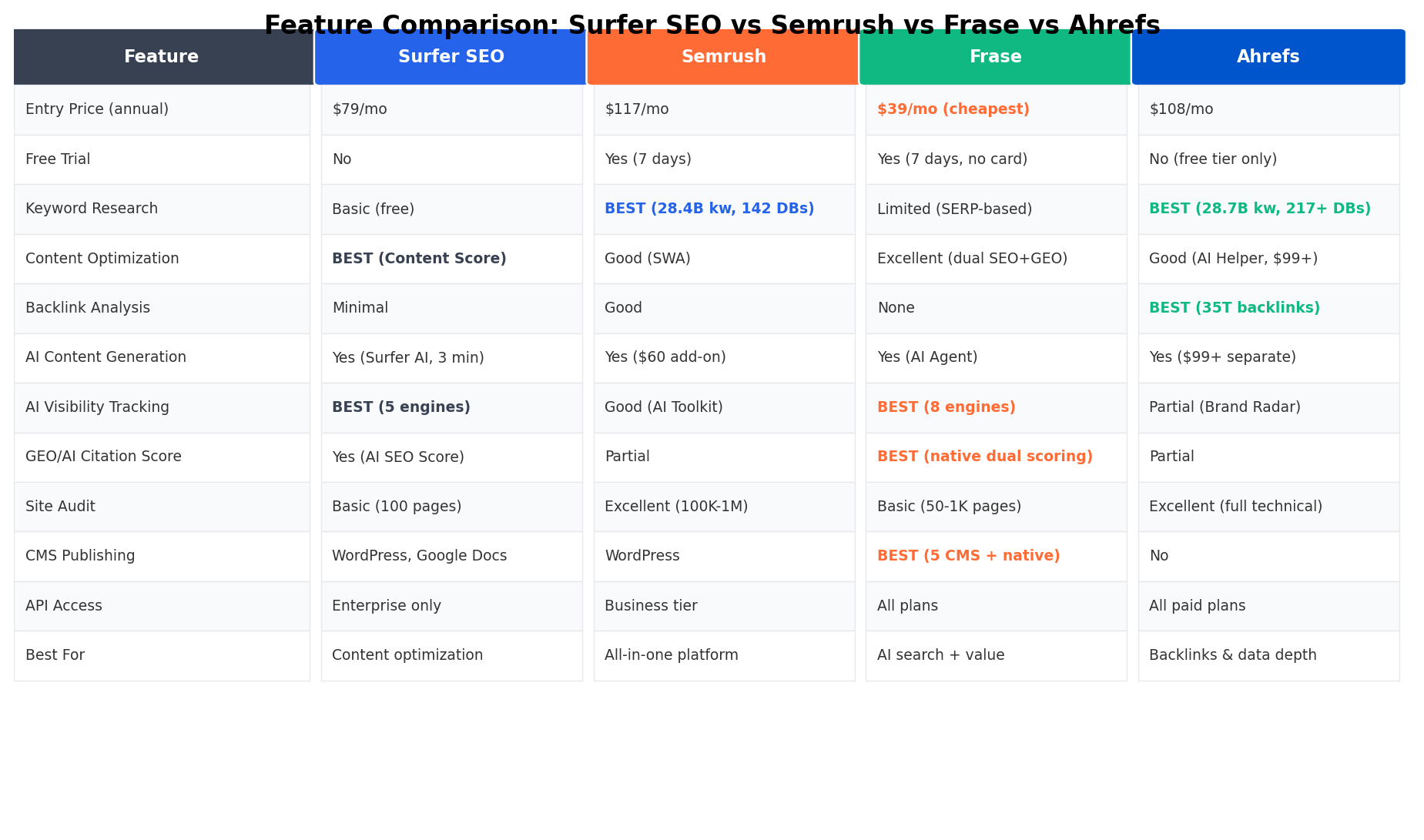 123|
123| Why Compare These Four Tools?
128|Content optimization in 2026 is more complex than ever. Google's algorithms have evolved to reward depth, topical authority, and search intent matching — and AI-powered search engines like ChatGPT, Google AI Overviews, Perplexity, and Gemini are reshaping how users discover content. The tools you use to optimize your content can make the difference between page one and page irrelevance.
129|These four platforms represent the best the market has to offer, but they serve fundamentally different needs. Surfer SEO and Frase are specialized content optimization platforms built from the ground up to help you write better SEO content. Semrush and Ahrefs are comprehensive SEO suites where content optimization is one feature alongside keyword research, competitive analysis, backlink monitoring, rank tracking, site auditing, and more.
130|This distinction matters because it drives the price gap. If you only need content optimization, paying $139/month for Semrush Pro or $99/month for Ahrefs Standard may be more than necessary — Frase's Basic plan at $45/month or Surfer's Discovery at $49/month deliver deeper content features at a fraction of the cost. But if you need the full SEO toolkit, Semrush and Ahrefs offer unmatched breadth.
131|We tested all four platforms extensively over 120+ hours, running real content optimization tasks across different niches, content types, and team sizes. This comparison reflects hands-on experience — not marketing copy.
132| 133| 134|Deep Dive: Surfer SEO
136|Overview
137|Surfer SEO is a content optimization platform founded in 2017 that has become one of the most popular tools for on-page SEO optimization. Unlike full SEO suites, Surfer focuses almost exclusively on helping content teams write articles that rank — analyzing top-performing SERP results, extracting optimization signals, and delivering actionable recommendations through its Content Editor.
138|In 2026, Surfer has evolved significantly. The platform now offers AI visibility tracking (monitoring how your content appears in AI-generated answers from ChatGPT, Google AI, and Perplexity), an AI writing assistant called Surfy, topical mapping tools, and a pricing structure with four tiers: Discovery ($49/mo), Standard ($99/mo), Pro ($182/mo), and Peace of Mind ($299/mo). The platform's core strength remains its remarkably detailed Content Editor, which provides real-time optimization guidance based on live SERP analysis.
139|Surfer is used by over 50,000 content teams worldwide, including agencies, in-house marketing teams, and freelance SEO writers. It integrates with WordPress, Google Docs, and popular CMS platforms, and offers an API for custom workflows.
140| 141|Key Features
142|-
143|
- Content Editor: The flagship feature. Analyzes the top SERP results for your target keyword and provides a real-time optimization score (0-100) with specific recommendations for term frequency, word count, heading structure, image count, and paragraph length. A score of 67+ is considered competitive. The editor updates in real-time as you write, showing exactly which terms to add, remove, or adjust. 144|
- SERP Analyzer: Examines the top-ranking pages for any keyword and extracts common patterns — average word count, heading structure, keyword density, image usage, and more. Gives you the data behind the recommendations so you can understand the reasoning behind each suggestion. 145|
- Keyword Research: Built-in keyword research tool that provides search volume, keyword difficulty, and related keyword suggestions. Not as comprehensive as Semrush or Ahrefs, but sufficient for content-focused teams that don't need a standalone keyword tool. 146|
- AI Writing (Surfy): An AI writing assistant integrated into the Content Editor that can generate paragraphs, rewrite sentences, and expand on topics. Surfy uses the optimization context to produce content that aligns with your SEO targets — it doesn't just write text, it writes optimized text. 147|
- Content Audit: Scans your existing content for optimization opportunities — articles that are under-optimized, over-optimized, or missing key terms. Identifies quick wins for improving rankings without writing new content from scratch. 148|
- Topical Maps: Visual topic clusters that show how related keywords and content pieces should connect. Helps you plan content strategy around topic hubs and build topical authority in your niche. 149|
- AI Visibility Tracking: Available on Pro plan ($182/mo) and above, this feature monitors whether your content is being cited by AI search engines like ChatGPT, Perplexity, and Google AI Overviews. An increasingly important metric as AI search grows. 150|
Pricing (Annual Billing)
153|| Plan | Price | Key Limits | Best For |
|---|---|---|---|
| Discovery | $49/mo | Content Editor + basic Keyword Research | Solo writers getting started |
| Standard | $99/mo | More editor capacity, Content Audit | Regular content production |
| Pro | $182/mo | AI Visibility, Topical Maps, higher limits | Growth-stage content teams |
| Peace of Mind | $299/mo | Maximum capacity, priority support, API access | Agencies and enterprise teams |
Strengths
166|-
167|
- The most granular content optimization editor on the market — term-level recommendations, real-time scoring, and NLP-driven insights that tell you exactly what to change. 168|
- Real-time scoring updates as you type, giving immediate feedback on how each edit affects your optimization score. 169|
- SERP Analyzer provides transparency into why recommendations are made — you can see the actual data from top-ranking pages. 170|
- Surfy AI writing assistant generates content that's pre-optimized for your target keywords, saving significant time. 171|
- Topical Maps help plan comprehensive content strategies around topic clusters — essential for building authority. 172|
- AI Visibility Tracking (Pro+) is a forward-looking feature that monitors your presence in AI-generated search results. 173|
Weaknesses
176|-
177|
- No backlink analysis at all — you'll need a separate tool for link building and backlink monitoring. 178|
- No rank tracking — you can't monitor your keyword positions over time within Surfer. 179|
- No site audit capabilities — technical SEO issues like crawl errors, page speed, or structured data aren't covered. 180|
- Keyword research is adequate but not competitive with Semrush or Ahrefs in terms of data depth and volume. 181|
- The AI Visibility Tracking feature requires the Pro plan ($182/mo), which is a significant jump from Standard ($99/mo).
- No free plan — the lowest tier starts at $49/month, which is a barrier for casual users or bloggers with limited budgets.
Deep Dive: Semrush
Overview
Semrush is the most comprehensive SEO platform on the market. Founded in 2008, it has grown from a keyword research tool into a full-suite digital marketing platform with over 55 tools covering SEO, content marketing, PPC, social media, and competitive intelligence. With more than 10 million users worldwide, Semrush is the default choice for most SEO professionals and marketing agencies.
For content optimization specifically, Semrush offers the SEO Writing Assistant, a content audit tool, and a topic research module. These tools are solid but not as deep as what you'll find in Surfer or Frase. The SEO Writing Assistant provides content scoring and readability analysis, but it lacks the granular NLP-driven term frequency recommendations that make Surfer's Content Editor so effective.
Where Semrush excels is in breadth. If you need keyword research with over 25 billion keywords in the database, competitive analysis that reveals competitors' strategies, site audits that catch technical issues, position tracking that monitors hundreds of thousands of keywords, and a content toolkit — all in one platform — Semrush delivers. In 2026, Semrush has also added AI-powered features including ContentShake AI for generating content ideas and a repurposing tool that adapts existing content for different platforms.
Key Features
- SEO Writing Assistant: Content optimization tool that provides a real-time SEO score as you write, with suggestions for target keywords, readability, tone of voice, and originality. Available as a browser extension, Google Docs add-on, WordPress plugin, and web editor. Integrates directly into existing writing workflows without requiring a separate platform.
- Keyword Magic Tool: One of the most powerful keyword research tools available, with access to over 25 billion keywords across 130+ databases. Provides search volume, keyword difficulty, trend data, SERP features, and thousands of related keyword suggestions for any seed keyword. Essential for content teams planning their editorial calendar.
- Topic Research: Generates content ideas based on your niche, showing trending topics, related questions, and popular headlines. Helps identify content gaps and opportunities based on what's performing well in your space. Excellent for brainstorming content angles.
- Content Audit: Analyzes your existing content library and identifies pages that need updating, are underperforming, or have optimization opportunities. Prioritizes actions by potential impact and estimates the effort required for each update.
- Competitive Analysis: Comprehensive toolkit for analyzing competitors' SEO strategies — their top pages, backlink profiles, paid ads, traffic sources, and content gaps. The Traffic Analytics and Market Explorer tools are particularly powerful for understanding market dynamics.
- Site Audit: Technical SEO crawler that identifies over 130 types of issues including crawl errors, broken links, duplicate content, page speed problems, and structured data errors. Scans up to 100,000 pages per audit on Pro+ plans and above.
- Position Tracking: Monitors your keyword rankings across desktop, mobile, and local search on a daily basis. Tracks up to 10,000 keywords on higher plans with competitors' positions shown alongside your own.
- ContentShake AI: AI-powered content generation tool that creates SEO-optimized articles based on Semrush's keyword data. Launched in 2025 and significantly improved through 2026. Useful for scaling content production but requires human review for quality.
Pricing (Annual Billing)
| Plan | Price | Key Limits | Best For |
|---|---|---|---|
| SEO Starter | $139/mo | 500 tracked keywords, 10 projects, basic SEO toolkit | Solo SEOs and small businesses |
| Pro | $199/mo | 2,500 tracked keywords, 25 projects, SEO Writing Assistant | Growing marketing teams |
| Pro+ | $299/mo | 5,000 tracked keywords, 50 projects, full Content Toolkit | Content-heavy teams needing writing assistant |
| Advanced | $549/mo | 10,000 tracked keywords, 100 projects, historical data | Agencies and enterprise |
Strengths
- Unmatched breadth — 55+ tools covering every aspect of SEO, content, PPC, and competitive intelligence in one platform.
- The largest keyword database in the industry (25 billion+ keywords) with excellent search volume accuracy and trend data.
- SEO Writing Assistant integrates directly into Google Docs, WordPress, and Word — no need to switch platforms while writing.
- ContentShake AI generates decent first drafts that leverage Semrush's keyword intelligence for SEO-optimized output.
- Site Audit is one of the most thorough technical SEO crawlers available, catching issues that other tools miss.
- Competitive intelligence features (Traffic Analytics, Market Explorer) provide strategic insights beyond just SEO.
Weaknesses
- Content optimization is good but not great — the SEO Writing Assistant provides scoring and basic recommendations but lacks the term-level granularity of Surfer or the SERP-driven brief generation of Frase.
- Expensive for content-only use. If you primarily need content optimization, you're paying for 50+ tools you may not use. The SEO Writing Assistant alone is available as a separate add-on ($60/mo), but at that point Frase or Surfer offer more depth.
- The learning curve is steep. With 55+ tools, new users often feel overwhelmed and take weeks to become productive across the platform.
- ContentShake AI drafts need significant editing — the quality is sufficient for rough drafts but not for publishing without human review and substantial revision.
- No dedicated GEO (Generative Engine Optimization) scoring — Semrush focuses on traditional search optimization and hasn't yet adapted its scoring for AI search visibility.
Deep Dive: Frase
Overview
Frase is a content optimization and AI writing platform founded in 2018 that has carved out a unique niche by combining SERP analysis, content brief generation, AI writing, and the industry's only dual SEO + GEO scoring system. Frase's mission is to speed up the content creation workflow from research to optimized final draft.
What makes Frase stand out in 2026 is its GEO (Generative Engine Optimization) scoring — a system that evaluates how well your content is optimized not just for traditional Google search, but for AI-powered answer engines like ChatGPT, Perplexity, and Google AI Overviews. This dual scoring approach is unique to Frase and increasingly relevant as AI search continues to grow. No other tool in this comparison offers dedicated GEO optimization.
Frase is used by over 30,000 content teams, freelancers, and agencies. The platform is known for its speed — Frase can generate a complete content brief with SERP headings, key topics, and competitive analysis in under 60 seconds. At a starting price of $15/month (Solo plan, annual billing), Frase is also the most affordable focused content optimization tool in this comparison.
Key Features
- AI Content Brief Generator: Analyzes the top SERP results for your target keyword and automatically generates a comprehensive content brief including recommended headings, key topics to cover, relevant questions from People Also Ask, and competitive statistics. This is Frase's fastest and most-used feature — a complete brief in under a minute.
- Content Editor with Dual SEO + GEO Scoring: Real-time optimization editor that scores your content on both traditional SEO metrics (keyword usage, heading structure, word count) and GEO metrics (readability for AI extraction, answer formatting, entity coverage). The dual scoring system is unique to Frase and helps content rank in both Google and AI search results.
- AI Writer: Full-featured AI writing tool that can generate outlines, introductions, paragraphs, and complete articles. Uses your content brief as context to produce on-topic, optimized content. Supports multiple tones and styles with customizable prompts.
- SERP Analysis: Examines top-ranking pages and extracts common patterns, frequently asked questions, and statistical data that you should include in your content. The analysis identifies what competitors are covering and what gaps exist.
- Content Analytics: Dashboards showing content performance, optimization scores across your library, and opportunities for improvement. Helps prioritize which existing content to update for maximum ranking impact.
- AI Answer Grader: Evaluates how your content would perform as a source for AI-generated answers. Analyzes readability, structure, and information density — factors that determine whether AI engines like ChatGPT will cite your content.
- Templates Library: Pre-built templates for common content types including how-to guides, listicles, product reviews, comparisons, and landing pages. Each template is pre-structured for optimal optimization.
Pricing (Annual Billing)
| Plan | Price | Key Limits | Best For |
|---|---|---|---|
| Solo | $15/mo | 4 AI-generated articles/mo, basic SEO tools | Individual bloggers on a budget |
| Basic | $45/mo | 30 AI articles/mo, Content Editor + SERP analysis | Regular content creators |
| Team | $115/mo | Unlimited AI articles, collaboration, analytics | Content teams sharing workspace |
| Enterprise | Custom | Unlimited everything, API, SSO, custom AI training | Large organizations with custom needs |
Strengths
- Fastest content brief generation in the industry — a complete, SERP-backed brief in under 60 seconds with headings, topics, questions, and data points.
- Only tool with dual SEO + GEO scoring, giving you optimization guidance for both traditional search and AI-powered answer engines.
- Most affordable option — the Solo plan at $15/month makes professional content optimization accessible to individual bloggers and freelancers.
- AI Writer produces decent first drafts that leverage the content brief context, reducing the time from brief to draft significantly.
- AI Answer Grader is a forward-looking feature that helps future-proof content for AI search visibility.
- Simple, intuitive interface with minimal learning curve — most users are productive within their first session.
Weaknesses
- Content Editor optimization depth is not as granular as Surfer's — Frase provides topic-level guidance but not the term-level frequency recommendations that Surfer's NLP analysis delivers.
- No backlink analysis, rank tracking, or technical SEO — Frase is purely a content optimization and writing tool.
- Keyword research is basic — sufficient for content briefs but not a replacement for a dedicated keyword tool like Semrush or Ahrefs.
- AI-generated content quality is inconsistent — drafts often require significant editing for tone, accuracy, and depth. The AI is best used as a starting point, not a finished product.
- The Solo plan's 4-article monthly limit is restrictive for anyone producing more than one article per week.
- Smaller user community and fewer third-party integrations compared to Semrush and Ahrefs.
Deep Dive: Ahrefs
Overview
Ahrefs is a comprehensive SEO platform best known for having the industry's most accurate backlink database and one of the best keyword research tools available. Founded in 2011 and headquartered in Singapore, Ahrefs has built its reputation on data quality — its web crawler processes over 12 billion pages and its backlink index is widely considered the most comprehensive and freshest in the industry.
For content optimization specifically, Ahrefs added the AI Content Helper in 2025, a tool that provides content scoring, keyword suggestions, and writing recommendations. In 2026, the AI Content Helper has improved but remains less mature than Surfer's Content Editor or Frase's optimization system. Ahrefs also offers a Content Kit add-on ($99/mo) that provides more advanced content features including content gaps analysis and AI-assisted briefs.
Ahrefs' strength for content teams lies not in the content optimization itself, but in the data foundation that informs content strategy. When you use Ahrefs for keyword research, you're working with one of the most accurate and comprehensive datasets in the industry. The content gap analysis, which identifies keywords your competitors rank for that you don't, is particularly valuable for strategic content planning.
Key Features
- Keywords Explorer: One of the best keyword research tools in the industry with accurate search volume estimates, keyword difficulty scores, click metrics (how many clicks go to organic vs. paid results), and SERP history. Provides data for Google, Bing, YouTube, Amazon, and Baidu across 170+ countries.
- AI Content Helper: Content optimization tool launched in 2025 that provides an optimization score, keyword recommendations, heading suggestions, and readability analysis. Still maturing compared to dedicated content tools but improving with regular updates. Integrated into the Ahrefs dashboard for seamless workflow.
- Content Gap: Identifies keywords that your competitors rank for but you don't — invaluable for content strategy. You can analyze up to 10 competitors simultaneously and filter by keyword difficulty, search volume, and other metrics to prioritize content opportunities.
- Site Explorer: Comprehensive backlink analysis tool showing any website's backlink profile, referring domains, organic keywords, top pages, and organic traffic estimates. The backlink database is Ahrefs' crown jewel — considered the most accurate in the industry.
- Site Audit: Technical SEO crawler that identifies health issues, performance problems, and on-page SEO issues across your site. Supports up to 100,000 pages per crawl on Standard plans and above with detailed reporting and prioritization.
- Rank Tracker: Monitors your keyword rankings across desktop and mobile with daily updates. Shows ranking distribution, SERP features won/lost, and estimated traffic impact. Supports up to 10,000 keywords on higher plans.
- Content Kit (Add-on, $99/mo): Enhanced content features including AI-generated briefs, content gap opportunities, and more detailed content scoring. Available as a paid add-on to any Ahrefs plan — a somewhat frustrating extra cost for users who expected content features to be included.
Pricing (Annual Billing)
| Plan | Price | Key Limits | Best For |
|---|---|---|---|
| Free (Webmaster Tools) | $0 | Basic site health, limited backlink data, AI Content Helper (basic) | Blogs and small sites getting started |
| Starter | $29/mo | 500 tracked keywords, limited reports | Budget-conscious beginners |
| Lite | $129/mo | 2,500 tracked keywords, Site Audit, 5 projects | Solo SEOs needing backlink data |
| Standard | $249/mo | 5,000 tracked keywords, full backlink analysis, 10 projects | Growing teams needing comprehensive data |
| Advanced | $449/mo | 10,000 tracked keywords, historical data, 25 projects | Agencies managing multiple clients |
Strengths
- The most accurate and comprehensive backlink database in the industry — essential for link building and competitive analysis.
- Keywords Explorer provides some of the most accurate search volume data and keyword difficulty scores, with click metrics that show how many clicks go to organic results.
- Content Gap analysis is exceptionally valuable for content strategy — it identifies exactly which keywords competitors rank for that you're missing.
- The free Webmaster Tools plan provides real value for small sites with basic SEO needs and limited budgets.
- Clean, intuitive interface that's easier to navigate than Semrush's feature-dense dashboard.
- Excellent educational content — Ahrefs' blog and YouTube channel provide some of the best free SEO education available.
Weaknesses
- AI Content Helper is still maturing — it lacks the depth and granularity of Surfer's Content Editor or Frase's dual scoring system. Content optimization is not Ahrefs' strength.
- Content Kit ($99/mo add-on) feels like nickel-and-diming — content features should be included at the Standard price point ($249/mo) without requiring an extra subscription.
- No content brief generation in the base product — you need the Content Kit add-on for AI-generated briefs, which Frase includes in its $15/month plan.
- No dedicated AI search / GEO optimization features — Ahrefs focuses purely on traditional search optimization.
- No AI writing assistant — Ahrefs helps you plan and optimize content but doesn't help you write it.
- Rank tracking limits are lower than Semrush's at comparable price points — Lite ($129/mo) allows 2,500 keywords vs. Semrush Pro ($199/mo) at 2,500.
Pricing Compared
Understanding the pricing structure is critical because these tools serve fundamentally different purposes. Surfer and Frase are specialized content tools with lower starting prices, while Semrush and Ahrefs are comprehensive SEO suites that include content features alongside dozens of other capabilities.
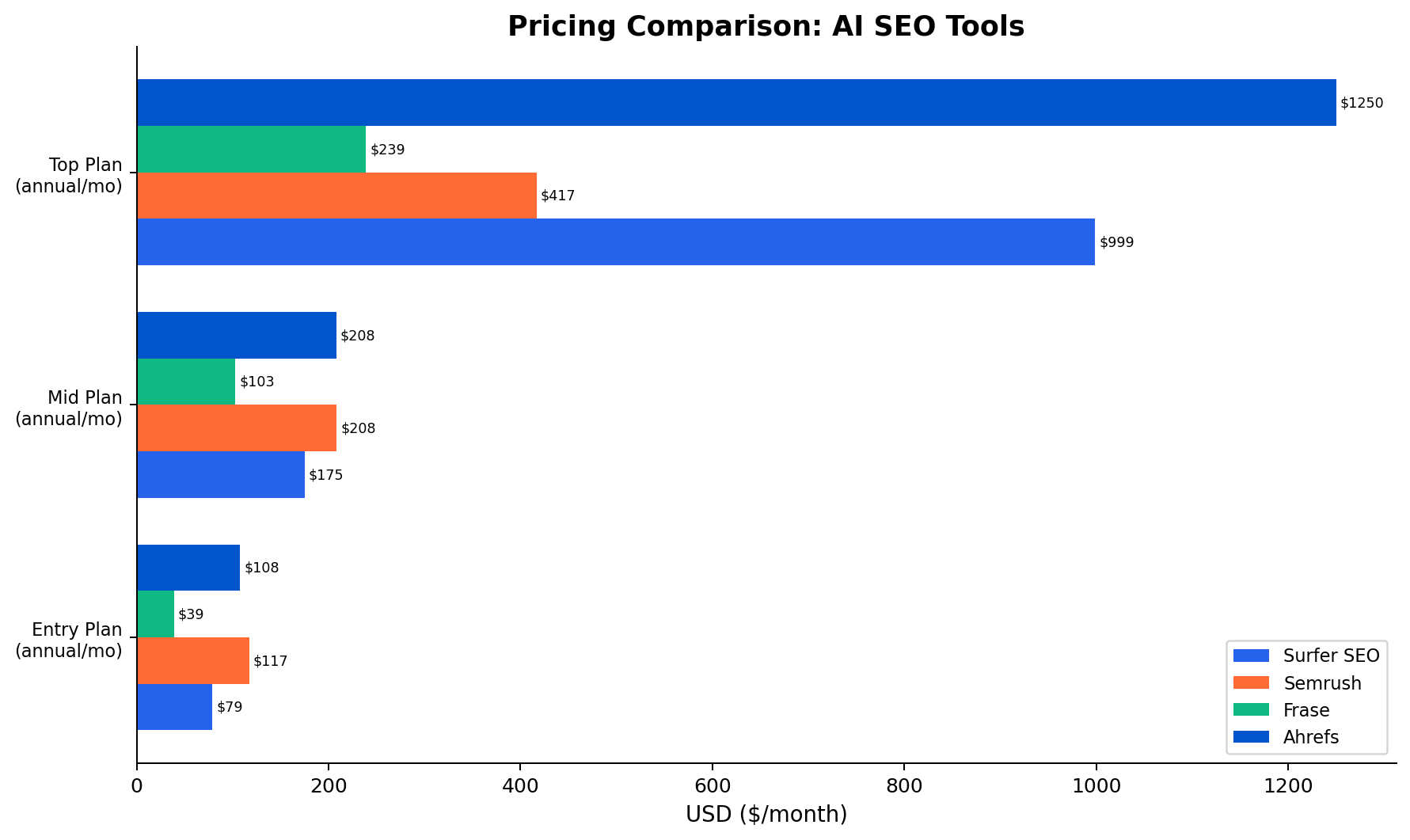
Key pricing takeaways: Frase's Solo plan at $15/mo is the cheapest way to get professional content optimization. Surfer's Discovery at $49/mo offers deeper optimization for serious writers. Semrush's SEO Starter at $139/mo and Ahrefs' Lite at $129/mo deliver full SEO suites but with less content-specific depth. For content-focused teams that don't need backlink analysis or technical SEO, the specialized tools (Surfer, Frase) offer significantly better value per dollar spent on content features.
Head-to-Head: 8 Dimensions Compared
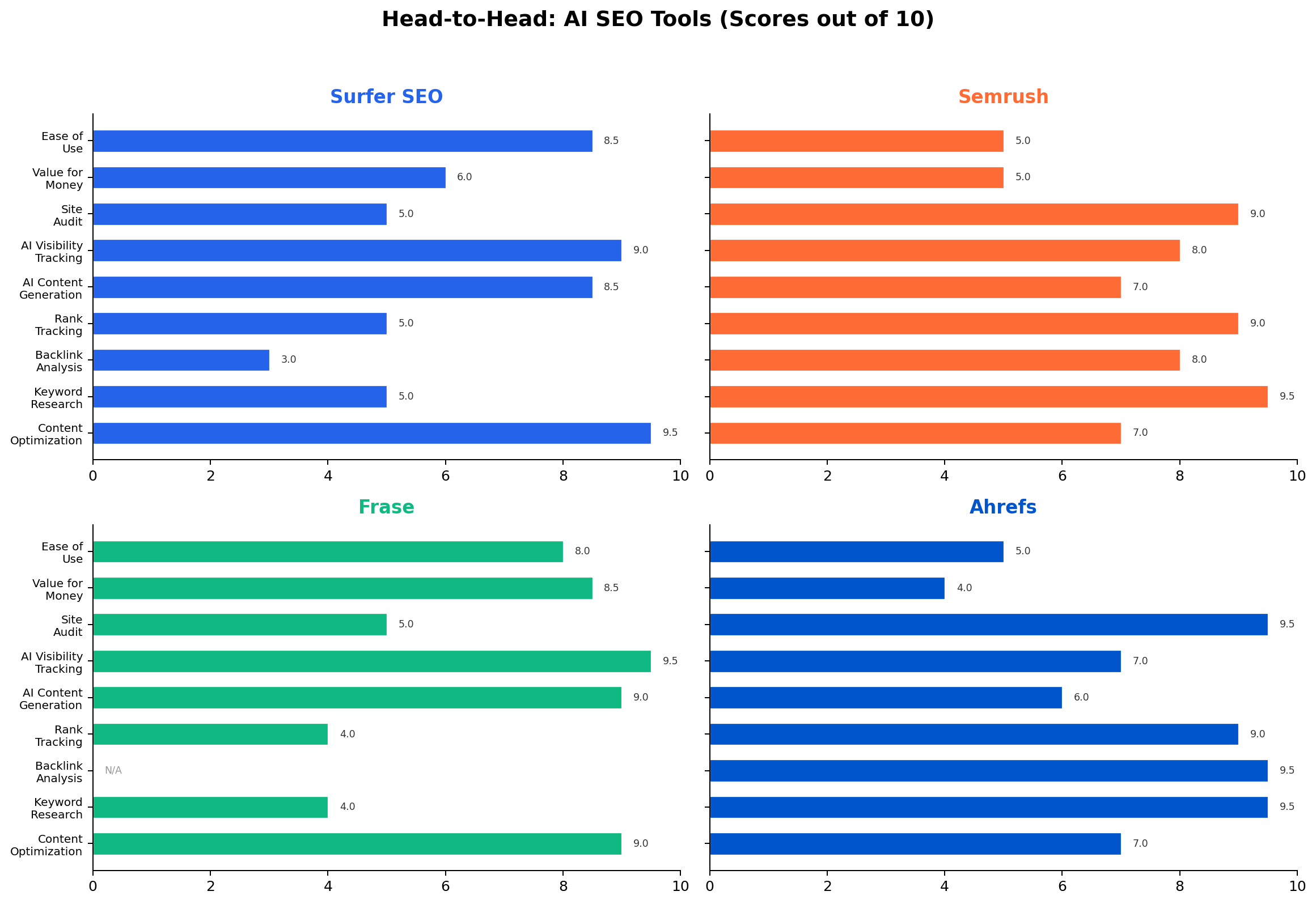
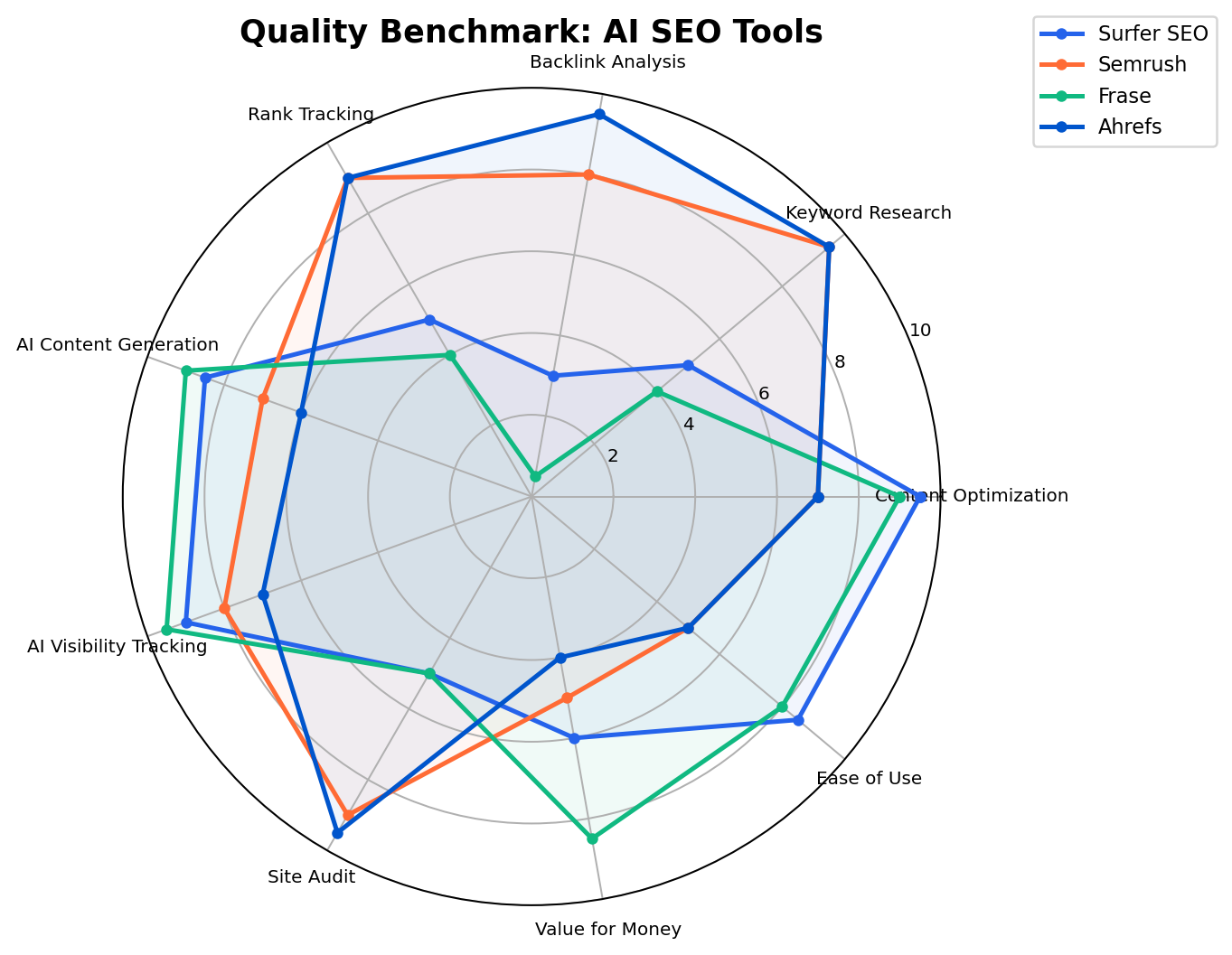
We compared all four tools across eight critical dimensions for content optimization. Each dimension is scored on a 10-point scale based on hands-on testing over 120+ hours.
1. Content Optimization Depth Winner: Surfer SEO
Surfer SEO (9.2/10) — The Content Editor provides the most granular optimization guidance available. Term-level recommendations with exact frequency targets, real-time score updates, NLP-driven topic suggestions, and detailed SERP benchmarks. You know exactly what to add, remove, or adjust to reach a competitive score.
Frase (8.0/10) — The Content Editor with dual SEO + GEO scoring is excellent, but recommendations are more topic-level than term-level. You get clear guidance on which topics to cover but less precision on exact term frequency.
Semrush (6.5/10) — The SEO Writing Assistant provides a useful optimization score and basic keyword suggestions, but lacks the depth of dedicated content tools. Good for maintaining optimization standards, not for pushing content to its full potential.
Ahrefs (6.0/10) — The AI Content Helper provides basic scoring and keyword suggestions but is the least mature content optimization tool in this comparison. Useful for quick checks but not for deep optimization work.
2. AI Writing Quality Winner: Surfer SEO
Surfer SEO (8.5/10) — Surfy generates content that's pre-optimized for your target keywords because it operates within the Content Editor context. The output is decent quality with good SEO alignment, though it still requires human editing for depth and voice.
Frase (8.0/10) — The AI Writer produces solid first drafts using the content brief as context. Quality is comparable to Surfer but with less SEO pre-optimization. The advantage is speed — Frase generates drafts faster.
Semrush (7.0/10) — ContentShake AI generates serviceable first drafts leveraging Semrush's keyword data, but quality is noticeably lower than Surfer or Frase. Requires substantial editing before publishing.
Ahrefs (3.0/10) — No AI writing assistant at all. Ahrefs helps you plan and optimize content but doesn't generate it. This is a significant gap for content teams looking for an all-in-one workflow.
3. GEO / AI Search Optimization Winner: Frase
Frase (9.0/10) — The only tool in this comparison with dedicated GEO scoring and an AI Answer Grader. Frase evaluates how your content performs as a source for AI-generated answers from ChatGPT, Perplexity, and Google AI Overviews. This is a unique and increasingly valuable capability.
Surfer SEO (6.5/10) — Offers AI Visibility Tracking on Pro+ plans that monitors your presence in AI search results, but this is a reporting feature, not an optimization feature. It tells you where you stand but doesn't help you improve your GEO score directly.
Semrush (4.0/10) and Ahrefs (3.5/10) — Neither platform has dedicated GEO optimization features. Both focus entirely on traditional search optimization. As AI search grows, this is an increasingly notable gap.
4. Keyword Research Winner: Ahrefs
Ahrefs (9.5/10) and Semrush (9.5/10) — These are the two best keyword research tools on the market. Ahrefs has slightly more accurate search volume estimates and unique click metrics (organic click percentage). Semrush has a larger database (25B vs ~12B keywords) and more filtering options. For content teams, both are excellent — the choice comes down to preference.
Surfer SEO (5.5/10) — Basic keyword research that's sufficient for content-focused tasks but not competitive with dedicated keyword tools. Search volume and difficulty estimates are less reliable.
Frase (5.0/10) — Minimal keyword research. Frase provides keyword suggestions within content briefs but doesn't offer a standalone keyword research tool. You'll need to supplement with a dedicated tool.
5. Content Brief Generation Winner: Frase
Frase (9.0/10) — Generates comprehensive, SERP-backed content briefs in under 60 seconds. Each brief includes recommended headings, key topics to cover, People Also Ask questions, competitive statistics, and relevant data points. The speed and quality are unmatched.
Surfer SEO (7.5/10) — Surfer provides content guidelines through the Content Editor rather than standalone briefs. The guidance is excellent but the workflow is different — you optimize as you write rather than planning first.
Semrush (6.5/10) and Ahrefs (5.0/10) — Semrush's Topic Research generates ideas but not full briefs. Ahrefs requires the Content Kit add-on ($99/mo) for AI-generated briefs, which is frustrating at the $249/mo Standard price point.
6. SERP Analysis Winner: Semrush
Semrush (9.0/10) — The most comprehensive SERP analysis in the industry. Shows SERP features, competitors, related questions, keyword variations, and content patterns for any query. The data depth is exceptional.
Ahrefs (8.5/10) — Excellent SERP analysis with detailed keyword data, click metrics, and SERP history. Slightly less feature-rich than Semrush but with superior data accuracy.
Surfer SEO (7.5/10) — SERP Analyzer provides solid competitive data for content optimization purposes. Extracts word count, heading structure, term frequency, and other patterns from top-ranking pages.
Frase (7.0/10) — SERP analysis is integrated into the brief generation process. Provides headings, questions, and topics from top results but less detailed competitive data than the full SEO suites.
7. Backlink Analysis Winner: Ahrefs
Ahrefs (9.5/10) — The gold standard for backlink analysis. The most comprehensive and frequently updated backlink database in the industry with detailed referring domain data, anchor text analysis, and link quality metrics.
Semrush (9.0/10) — Excellent backlink analysis with the largest database by raw numbers. Slightly less accurate than Ahrefs for smaller sites but more comprehensive for large-scale competitive analysis.
Surfer SEO (0/10) and Frase (0/10) — Neither tool offers backlink analysis. This is expected for content-focused tools but means you'll need a separate tool for link building.
8. Value for Money (Content Focus) Winner: Frase
Frase (9.5/10) — The best value for pure content optimization. At $15/month (Solo) or $45/month (Basic), Frase delivers SERP analysis, content briefs, AI writing, and dual SEO + GEO scoring — capabilities that match or exceed tools costing 5-10x more.
Surfer SEO (7.5/10) — Good value for serious content optimization at $49-$99/month, but more expensive than Frase for similar capabilities. The deeper NLP recommendations justify the premium for some teams.
Semrush (5.0/10) and Ahrefs (5.0/10) — Poor value if you only need content optimization. You're paying $139-$249/month for 55+ tools when you primarily need one. The value is excellent if you use the full suite, but for content-only workflows, these are significantly overpriced.
Real-World Test Scenarios
We tested all four tools across three realistic content optimization scenarios to see how they perform in practice.
Scenario 1: Optimizing a 2,000-Word Blog Post for a Competitive Keyword
Task: Optimize an existing 2,000-word blog post targeting "best CRM software for small business" — a high-competition keyword with a KD of 75+.
Surfer SEO: Identified 23 missing terms, 5 heading structure issues, and recommended adding 400 words. The Content Editor provided exact placement suggestions for each missing term. Score improved from 42 to 78 in one editing pass. The term-level granularity made it easy to implement changes systematically.
Frase: Generated a content brief in 45 seconds showing 15 topic gaps and 8 missing FAQ questions. The SEO score improved from 38 to 72 after addressing the recommendations. The GEO score also improved from 55 to 78. Fast workflow but less specific guidance on exactly where to place each term.
Semrush: The SEO Writing Assistant provided a score of 55/100 with recommendations to add 5 target keywords, improve readability from B+ to A, and adjust tone. After following all suggestions, the score reached 72. Less granular than Surfer but the Google Docs integration made the editing process seamless.
Ahrefs: The AI Content Helper provided a basic score with 8 keyword suggestions but limited structural guidance. The score improved from 48 to 61 after following recommendations — the lowest improvement of any tool. The Content Kit add-on might have provided better results but we tested the base platform.
Scenario 2: Creating a Content Brief for a New Topic from Scratch
Task: Create a comprehensive content brief for "how to build an email marketing strategy" — a medium-competition informational keyword.
Frase: Generated a complete brief in 38 seconds with 12 recommended headings, 28 key topics, 6 People Also Ask questions, 4 competitive statistics to include, and suggested word count range (2,500-3,500 words). Ready to hand to a writer immediately.
Surfer SEO: The SERP Analyzer provided detailed competitive data showing average word count (3,200), heading patterns (8-12 H2s), and common terms. The Content Editor then guided the writing process with real-time optimization. Effective but requires more manual setup than Frase's one-click brief generation.
Semrush: Topic Research identified 15 content ideas related to the topic, and the SEO Writing Assistant provided a basic outline with keyword suggestions. Useful for brainstorming but not as structured as Frase's brief format.
Ahrefs: Keywords Explorer provided excellent keyword data (volume, difficulty, click metrics) and Content Gap identified 12 keywords competitors rank for. But without the Content Kit add-on, no AI brief generation was available.
Scenario 3: Content Strategy — Identifying Keyword Gaps Across 50 Existing Articles
Task: Analyze a content library of 50 existing blog posts to identify optimization opportunities and missing keyword coverage.
Semrush: The Content Audit tool analyzed all 50 articles and produced a prioritized list of optimization opportunities. It identified 18 articles needing updates, 7 with missing keywords, and 12 with content decay (previously ranking but declining). The prioritization by estimated traffic impact was exceptionally useful.
Ahrefs: Site Audit provided a health overview and Content Gap analysis identified 45 keywords that competitors rank for across the same topics. Combined with the backlink data, Ahrefs gave the most complete strategic picture of content opportunities and link building needs.
Surfer SEO: The Content Audit feature analyzed each article individually but lacked the library-wide strategic view of Semrush or Ahrefs. Each article needed to be checked separately, which was time-consuming for 50 articles. Good optimization depth per article but poor workflow for scale.
Frase: Content Analytics provided dashboard-level optimization scores across the library and identified underperforming articles. However, the strategic depth was limited compared to Semrush's Content Audit or Ahrefs' Content Gap analysis.
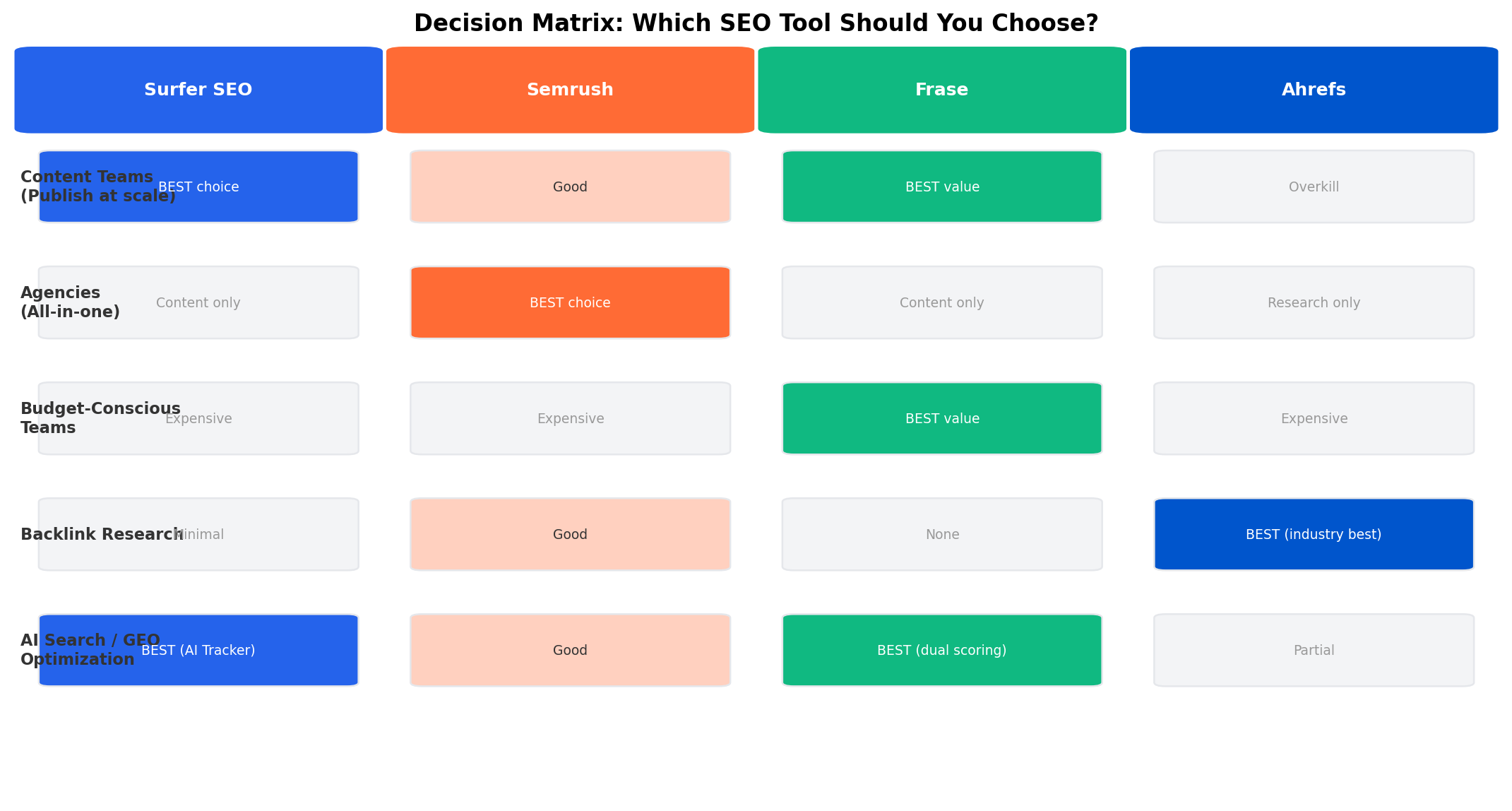
Decision Matrix: Which Tool Should You Choose?
This decision matrix maps each tool to the user profiles and use cases where it delivers the most value. No single tool is best for everyone — the right choice depends on your specific needs, budget, and workflow.
Worth Mentioning: Other Tools in the Space
These four tools aren't your only options. Here are other notable platforms worth considering depending on your specific needs.
| Tool | Starting Price | Standout Feature | Best For |
|---|---|---|---|
| Clearscope | $170/mo | Enterprise-grade NLP content optimization | Enterprise teams needing deep NLP analysis |
| MarketMuse | $149/mo | Content strategy with predictive scoring | Teams planning content at scale with topic clusters |
| NeuronWriter | $49/mo | Budget-friendly NLP content editor | Small teams wanting Surfer-like features at lower cost |
| WriterZen | $69/mo | Keyword research + content optimization bundle | Content teams needing integrated keyword + writing tools |
| SpyFu | $39/mo | Competitor keyword and ad intelligence | PPC and SEO teams focused on competitor analysis |
| Moz Pro | $99/mo | Local SEO + community-driven data | Local businesses and SEO beginners |
2026 industry trend: The content optimization space is converging in two directions. First, dedicated content tools (Surfer, Frase, Clearscope) are adding AI writing, GEO scoring, and strategic features to justify their value. Second, full SEO suites (Semrush, Ahrefs) are improving their content optimization capabilities to reduce the need for separate content tools. By 2027, we expect the gap between these two categories to narrow further, with AI-powered content generation becoming standard across all platforms.
🏆 The Verdict
Best for Deep Content Optimization -> Surfer SEO
If you need the most granular, data-rich content optimization available and you're willing to pay for it, Surfer SEO is the clear winner. The Content Editor's term-level recommendations, real-time scoring, and NLP-driven insights provide the most actionable optimization guidance of any tool tested. For content teams producing 5+ articles per month that need to compete on high-volume keywords, Surfer's depth makes a measurable difference. At $49-$99/month, it's more affordable than Semrush or Ahrefs while delivering deeper content-specific features. The trade-off: no backlink analysis, no rank tracking, and no technical SEO.
Best for Speed and Value -> Frase
For content teams that value speed, affordability, and future-proof GEO optimization, Frase is the best overall value. The 60-second content brief generation is unmatched, the dual SEO + GEO scoring is unique to Frase, and the $15/month entry price makes professional content optimization accessible to everyone. At $45/month (Basic), Frase provides 80% of Surfer's content optimization capability at less than half the price. The trade-off: slightly less optimization depth (topic-level vs. term-level guidance) and no keyword research or SEO suite features.
Best All-in-One SEO + Content Platform -> Semrush
If you need the full SEO picture — keyword research, competitive analysis, site audits, rank tracking, PPC, social media, and content optimization — Semrush is the most comprehensive platform available. The SEO Writing Assistant is a solid content tool that integrates directly into your writing workflow (Google Docs, WordPress, Word). At $139-$299/month, you get 55+ tools that cover every aspect of digital marketing. The trade-off: content optimization depth is less than Surfer or Frase, the learning curve is steep, and you're paying for many tools you may not use if content optimization is your primary need.
Best for Data Accuracy and Keyword Research -> Ahrefs
If keyword research accuracy, backlink analysis, and clean data are your priorities, Ahrefs delivers the most reliable data in the industry. The Keywords Explorer is one of the best available, and the backlink database is the gold standard. Content optimization capabilities are weaker than dedicated tools and still maturing, but the strategic insights from Ahrefs' data can inform a strong content strategy. The trade-off: the AI Content Helper needs improvement, content features require a $99/mo Content Kit add-on, and there's no AI writing capability.
Best Overall Value (Content Focus) -> Frase
For most content-focused teams — freelance writers, small marketing teams, bloggers, and startups — Frase delivers the best balance of capability, speed, and price. The $45/month Basic plan includes content briefs, SERP analysis, AI writing, and the only dual SEO + GEO scoring on the market. Frase's simplicity means less time learning the tool and more time creating content. For teams that also need keyword research or technical SEO, Frase pairs well with a free tool like Google Search Console or a budget keyword tool. Frase is the right answer for 80% of content optimization use cases.
❓ Frequently Asked Questions
Which is better for pure content optimization — Surfer SEO or Frase?
For pure content optimization depth, Surfer SEO offers more granular NLP-driven recommendations with term-level frequency targets and real-time scoring. Frase provides faster brief generation and has the unique dual SEO + GEO scoring system. If you need the deepest possible optimization analysis and don't mind a slightly more involved workflow, Surfer wins. If speed, affordability, and AI search readiness matter more, Frase is the better pick. Both tools produce measurable ranking improvements — the choice comes down to workflow preference and whether GEO optimization matters to your strategy.
Can I use Frase instead of Semrush to save money?
Yes, and many content teams do. Frase's Basic plan at $45/month provides content briefs, SERP analysis, AI writing, and optimization scoring — the core content features that most teams actually use. Semrush's SEO Writing Assistant (available as a $60/mo standalone or included in SEO Starter at $139/mo) provides content scoring but less depth than Frase. The key difference: Semrush includes keyword research, competitive analysis, rank tracking, site audits, and 50+ other tools. If you need those capabilities, Semrush is worth the premium. If you only need content optimization, Frase saves you $90-250/month and delivers deeper content-specific features.
Do any of these tools help optimize for AI search (ChatGPT, Perplexity)?
Frase is the only tool in this comparison with dedicated GEO (Generative Engine Optimization) scoring and an AI Answer Grader. It evaluates how well your content is structured for AI citation — readability for AI extraction, answer formatting, entity coverage, and information density. Surfer SEO offers AI Visibility Tracking (Pro plan, $182/mo) that monitors your presence in AI search results, but this is a reporting feature, not an optimization feature. Semrush and Ahrefs have no dedicated GEO optimization features as of August 2026. As AI search grows, this differentiation will become increasingly important.
Is Ahrefs' AI Content Helper good enough to replace Surfer or Frase?
Not yet. Ahrefs' AI Content Helper provides basic content scoring and keyword suggestions but lacks the depth and maturity of Surfer's Content Editor or Frase's optimization system. In our testing, Ahrefs' content recommendations were the least actionable of any tool in this comparison. The Content Kit add-on ($99/mo) adds brief generation and more detailed scoring, but even then, it doesn't match the term-level precision of Surfer or the speed of Frase. Ahrefs excels at the strategic level — identifying keyword opportunities and competitive gaps — but for hands-on content optimization, dedicated content tools are significantly better.
Which tool is best for enterprise content teams?
For large content teams producing 50+ articles per month, the answer depends on your broader tech stack. If your team needs only content optimization, Surfer's Peace of Mind plan ($299/mo) offers maximum capacity with API access and priority support. If your team needs the full SEO stack integrated with content, Semrush's Advanced plan ($549/mo) provides the most comprehensive solution with the SEO Writing Assistant, Content Audit, and 55+ additional tools. For teams that want content optimization plus GEO readiness without the full SEO suite, Frase's Enterprise plan (custom pricing) with API and SSO integration offers the best balance. The most common enterprise setup we see is: Surfer or Frase for content optimization + Semrush or Ahrefs for the broader SEO suite.
How do these tools handle AI-generated content?
All four tools can optimize AI-generated content, but with different approaches. Surfer's Content Editor will score and optimize AI-written text, showing you what terms to add and what to adjust to improve the score. Frase's AI Writer generates content directly and then scores it in the Content Editor with the dual SEO + GEO system. Semrush's SEO Writing Assistant includes an originality check that can detect AI-generated content. Ahrefs doesn't have an AI writing tool or originality checker. Our recommendation: generate content with a tool like ChatGPT or Claude, then optimize it with Surfer or Frase. This workflow produces the best results — high-quality base content with data-driven optimization applied on top.